

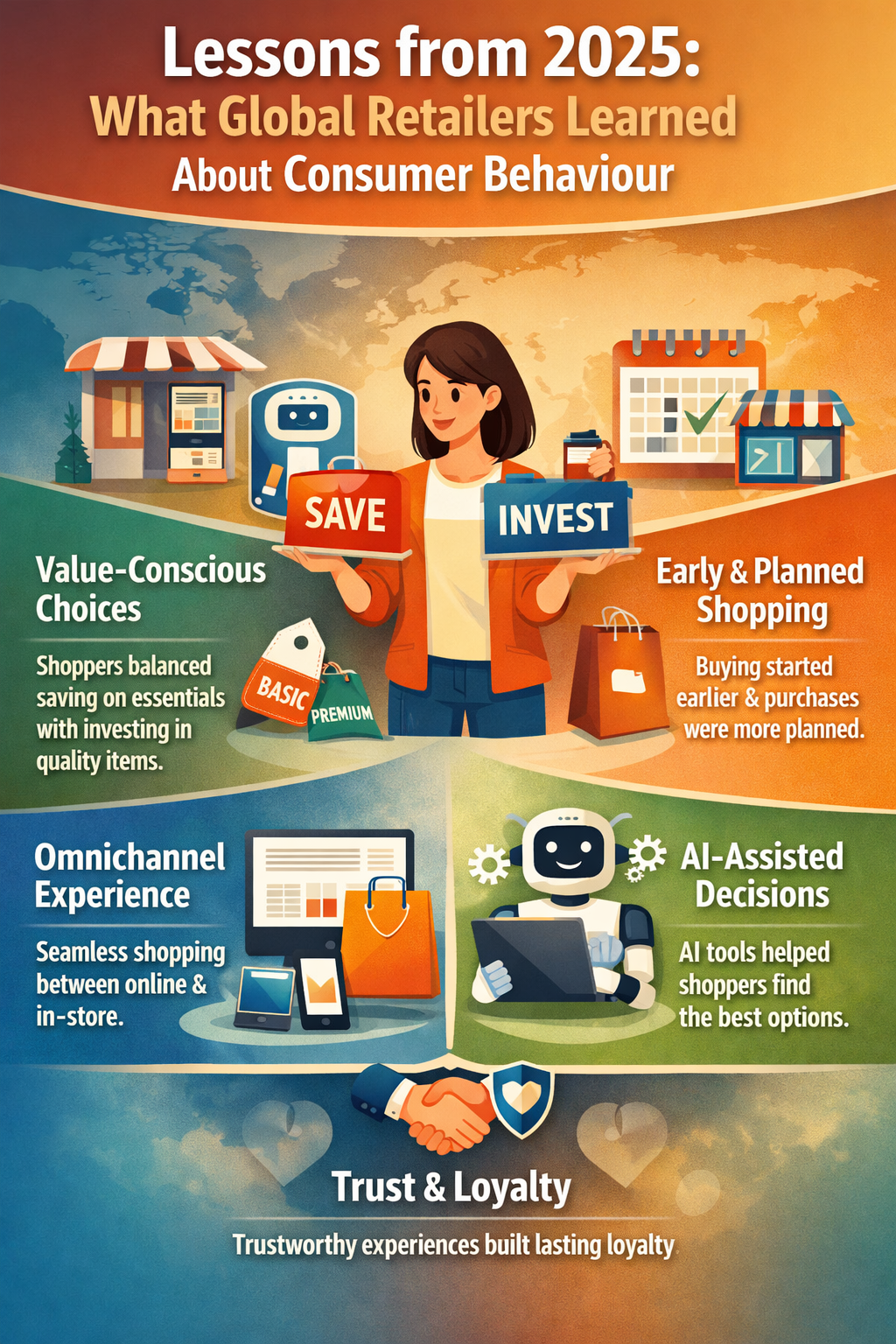
If 2025 taught retailers one big lesson, it is this: consumers did not stop buying, they became much better decision-makers. Shoppers were more informed, more selective, and far more intentional than in previous years. That shift was not driven by fear or pessimism, but by adaptation. Consumers learned how to balance their budgets without giving up on things that genuinely matter to them.
For retailers, 2025 was less about dramatic disruption and more about clarity. The signals were there, consistent across markets, categories, and channels. The retailers who performed best were those who understood how people actually think when they shop today.
Value is no longer just about price
In 2025, value stopped being a label and became a behavior. Consumers did not simply chase discounts. Instead, they asked themselves a quieter but more powerful question: “Is this a smart choice for me right now?”
That mindset explains why shoppers were happy to save on everyday items while still investing in products that promised durability, energy efficiency, or long-term usefulness. Price still mattered, but only in context. A higher price felt acceptable when the benefit was clear and the decision felt rational.
Retailers who communicated value clearly did well. Clear price ladders, transparent comparisons, honest promotions, and visible quality signals helped customers feel confident rather than pressured. Private labels, refurbished products, and bundled offers worked especially well because they allowed customers to feel clever, not constrained.
Shoppers learned to mix saving and spending
One of the most interesting patterns of 2025 was what many now call the “selective premium spending.” Consumers became very comfortable saving in one category and spending more in another, sometimes during the same shopping trip.
This behavior is not contradictory. It is practical. People protected their budgets by cutting where it felt painless, and then rewarded themselves where the value felt meaningful. In consumer electronics, for example, shoppers were cautious overall, yet still willing to invest in products that improved daily life, supported work, or reduced future costs.
For retailers, this means assortments need flexibility. It is no longer enough to offer a simple good-better-best structure. Customers want a clear entry point and a clearly justified upgrade. When the difference is easy to understand, shoppers are far more willing to move up.
Shopping started earlier and became more planned
Another clear lesson from 2025 is that consumers plan more and rush less. Promotions started earlier, research began weeks in advance, and purchases were spread across longer periods. This reduced last-minute pressure, but increased expectations.
Customers now expect retailers to be ready earlier. Stock availability, product information, reviews, and promotions all need to be in place sooner, because the decision-making process starts long before the final click or store visit.
Retailers who adapted their calendars and planning cycles benefited from this shift. Those who waited for traditional peak weeks often found that the customer had already decided elsewhere.
Digital guides the journey, stores close the deal
Despite strong growth in online research and ordering, physical stores remained highly relevant in 2025. Consumers used digital channels to compare, check availability, and reduce uncertainty. They used stores to confirm decisions, get advice, and take products home immediately.
This is not an online versus offline story. It is a connected experience story. Shoppers expect consistency across channels. They want prices, availability, and information to match. When that happens, trust increases and hesitation drops.
Retailers who treated omnichannel as one experience rather than separate operations saw stronger engagement. The store was no longer just a place to transact, but a place to reassure and support the final decision.
AI quietly became part of everyday shopping
In 2025, artificial intelligence stopped feeling futuristic and started feeling normal. Many shoppers used AI-powered tools without thinking too much about the technology behind them. They used them to compare products, narrow choices, and save time.
Interestingly, consumers do not need to love AI to use it. They only need it to be helpful. When AI explained options clearly, suggested relevant alternatives, or simplified complex decisions, shoppers embraced it. When it felt intrusive or confusing, they ignored it.
The lesson for retailers is simple: AI should solve real problems. Helping customers choose the right product, understand trade-offs, or avoid mistakes builds confidence and satisfaction. Technology works best when it feels invisible and supportive.
Loyalty depends on experience, not programs
Many retailers entered 2025 hoping loyalty programs would protect them. What became clear is that loyalty is fragile if the experience does not deliver. Points and apps matter far less than reliability, clarity, and ease.
Customers stayed loyal when retailers consistently met expectations: accurate information, fair pricing, smooth returns, and helpful service. When those basics failed, loyalty quickly weakened, no matter how strong the program looked on paper.
Loyalty in 2025 was earned through repeated positive experiences, not promised through rewards alone.
Trust moved closer to daily operations
Trust in 2025 went beyond brand image. Consumers paid attention to how retailers handled data, privacy, and technology. Transparency, especially around personalization and AI use, became part of the shopping experience.
Retailers that communicated clearly and acted responsibly benefited from higher confidence and repeat engagement. Trust became something customers felt during everyday interactions, not something communicated only through branding.
Looking ahead with confidence
The most encouraging lesson from 2025 is that consumers are not unpredictable. They are thoughtful. They want clarity, fairness, and support in making good decisions. Retailers who respect that mindset and design experiences around it are well-positioned for the future.
As we move into 2026, success will likely come from doing a few things consistently well: making value easy to understand, offering meaningful choices, connecting digital and physical journeys, using technology responsibly, and earning trust through everyday excellence.
Retail in 2025 was not about surviving change. It was about understanding people better. And that is a lesson worth carrying forward.
by: Dario Sipos


Recent Comments